Zingerone
-
- Category :
Organic chemicals and Derivatives/Aroma compounds
- CAS NO : 122-48-5
- EC NO : 204-548-3
- Molecular Formula : C11H14O3
- Main Specifications : 99% min
- Synonyms : Vanillylacetone;4-(4-Hydroxy-3-methoxyphenyl)butan-2-one;
Package: 25kg 50kg drum or bag
Uses : a naturally occurring active ingredient in ginger, with multiple uses
Molecular Structure:
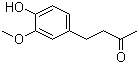
Product description:
What is the chemical of Zingerone?
Appearance: White to light yellow solid (crystalline) ;
Assay:99%min by HPLC ;
IR Identity: conform to standard ;
HNMR: conform to standard ;
carbon spectrum: conform to standard ;
Water by K. F.:0.5% max or as per the customer’s request ;
Loss on drying:0.5% max. or as per the customer’s request ;
Melting point: 40–41 °C;
boiling point: At standard atmospheric pressure (760 mmHg), the boiling point is approximately 323.0 ° C;
==============================================================================
Usage: Ginger ketone is a naturally occurring active ingredient in ginger, with multiple uses:
Food industry: As an important food flavoring, it endows food with rich ginger aroma and spicy sweetness, which complies with the provisions of China's "Hygienic Standards for the Use of Food Additives" (GB 2760-1996).
Medicine and scientific research: It has biological activities such as anti-inflammatory, anti diabetes, anti-tumor, anti diarrhea, anti spasticity, and relieving oxidative stress, and is commonly used in pharmacological research and as a reference substance.
Cosmetics and essence: As a component of essence, it is used in perfume, skin care products and other products
==============================================================================
Synthesis route: Detailed chemical synthesis steps are not provided in public information. However, gingerone can be obtained through supercritical CO ? extraction of ginger. The process involves washing, slicing, drying, and crushing the ginger, extracting it with supercritical CO ?, and then distilling it under reduced pressure to obtain ginger oleoresin, which ultimately separates gingerone.



 Search Product