4-Chlorophenol
-
- Category :
Dyestuffs and Pigments
- CAS NO : 106-48-9
- EC NO : 203-402-6
- Molecular Formula : C6H5ClO
- Main Specifications : 99% min
- Synonyms : 4-Chlorophenol solution;Parachlorophenol;Para chlorophenol;4-chloro phenol;4-chloro-1-hydroxybenzene;4-chloro-pheno;4-Chlorophenol(form2);4-chloro-phenole;Applied 3-78;applied3-78;chlorophenols,solid;p-Chlorfenol; P-CHLORO PHENOL;4-Hydroxychlorobenzene;4-chlorophenol;Benzene, 1-chloro-4-ethoxy-;Chlorophenol, 4-;
Package: 25kg 50kg drum or bag
Uses : Used for microscopy analysis, pharmaceutical and dye intermediates, alcohol denaturing agents, solvents
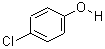
Molecular Structure:
Product description:
What is the chemical of 4-Chlorophenol ?
Appearance: White crystals or Gray white to light yellow brown ;
Assay: 99% min by HPLC ;
IR Identity: conform to standard ;
HNMR: conform to standard ;
carbon spectrum: conform to standard ;
Water by K. F.:0.5% max or as per the customer’s request ;
Loss on drying:0.5% max. or as per the customer’s request ;
===========================================================
There are various production methods for this product, mainly including the following: 1. Phenol direct chlorination method. Phenol is used as the raw material, and it is divided into the following three methods according to the different chlorinating agents and solvents used: (1) Sulfuric chloride method. Phenol is heated and melted, cooled to 40 ℃, slowly added with thionyl chloride, which takes about 40-45 minutes to add, then stirred for 4 hours, heated to 30-40 ℃ and kept for 4 hours, and kept at 40-45 ℃ for 4 hours. The reaction tail gas is absorbed with alkaline solution, cooled to room temperature after reaction, washed with water, 10% sodium carbonate solution, and water in sequence, and distilled under reduced pressure to collect the 110-115 ℃ (2.67kPa) fraction to obtain p-chlorophenol. This method has a high yield of 70% -75% for chlorophenol. At the same time, 25-30% of the by-product ortho chlorophenol is generated. Each ton of chlorophenol consumes approximately 1000kg of phenol and 2000kg of thionyl chloride. (2) The benzene solvent method uses benzene as the solvent and chlorine gas as the chlorinating agent to directly chlorinate phenol to produce this product. (3) The solvent-free chlorination method uses iron, bromine, and other catalysts to pass chlorine gas into molten phenol and directly chlorinate it to produce monochlorophenol. After washing, the reaction solution is subjected to vacuum distillation to collect fractions with a p-chlorophenol content of ≥ 95%. The yield based on phenol (total ortho/para) is ≥ 95%, the yield based on chlorine is 95%, the para/ortho ratio is 3-4, and the product content is ≥ 98%. Raw material consumption quota: 0.77t/t phenol, 0.58t/t chlorine gas. By product hydrogen chloride 0.28t/t. 2. The p-chlorobenzene hydrolysis method uses p-dichlorobenzene as the raw material and water, alcohol, or benzene as the solvent to prepare it. 3. Chlorination solution of ortho -, para chlorophenol, and 2,4-dichlorophenol obtained by chlorination with sodium phenolate. Decompression distillation, collect high boiling point fractions at 85-132 ℃ (2.0kPa), cool them to below 10 ℃, and then precipitate p-chlorophenol, which is obtained by separation. The yield is about 25%. 4. Obtained from diazotization and cuprous chloride substitution of para aminophenol. 5. Obtained from diazotization, hydrolysis, and elimination of p-chloroaniline.
MP: 42-45 °C
=======================================================
It has a wide range of uses, mainly including:In the industrial field, as an intermediate in the pesticide, pharmaceutical, dye, and plastic industries, it is used to synthesize specific products such as triadimefon, vancomycin, dye neutral brilliant green BL, and drug ampicillin.
Special applications: Used as a microscope analysis reagent, ethanol color changing agent, selective solvent for refined mineral oil, and preservative, etc
===========================================================
This product is also used for pesticides; Medicine; Dyes; Plastic and other industries, also used as ethanol color changing agents; Selective solvent for refined mineral oil; Microscopic analysis, etc; The agricultural industry is mainly used for the synthesis of pyruvic acid; Wei Jun ketone; Wool fungicide; Anti falling substance; Propiconazole; Poisonous rat phosphorus; Insecticides, etc., used to manufacture pesticide fungicides 5,5 'dichloro-2,2' dihydroxydiphenylmethane and plant growth promoters; The dye industry is used to produce 1,4-dihydroxyanthraquinone, 1,4-diamino anthraquinone, para aminophenol, and hydroquinone, among others; Used in the pharmaceutical industry for carboxylation to produce sodium 5-chloro-2-hydroxybenzoate, synthesis of 4-chlorophenoxyisobutyric acid, and other drugs; It is also used for synthesizing antioxidants such as BHA (butyl hydroxyanisole).



 Search Product